
The Core Distinction: Construction and First Impressions
Flat Handle Paper Bags
Flat handle paper bags, also called tape handle bags, use a single strip of paper folded and glued inside. They are efficient, practical, and fold flat for compact storage and shipping.
Twisted Handle Paper Bags
Twisted handle paper bags feature handles made from tightly twisted paper strands, reinforced and attached inside. This creates a more three-dimensional, comfortable grip and a distinct visual appeal, often standing upright even when empty.
Is a flat handle bag truly more economical for eco-brands?
Flat handle bags typically use fewer materials and simpler production, leading to lower unit costs. This makes them ideal for brands with tight margins or high-volume needs, offering efficiency in material use and automated assembly. If your business prioritizes cost-effectiveness and streamlined operations without sacrificing environmental integrity, flat handles deserve serious consideration.
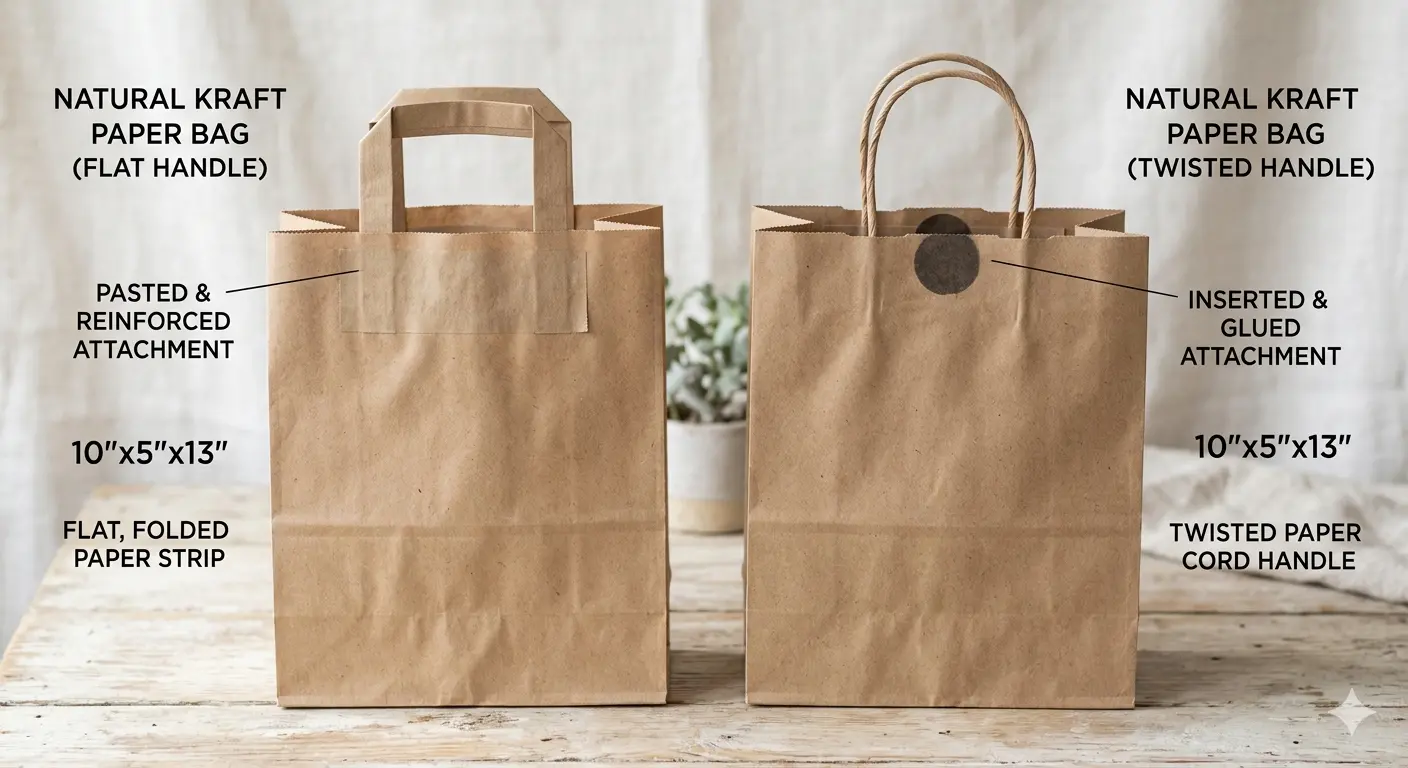
However, “economical” isn’t only about the initial purchase price. Look, everyone talks unit cost. But the real savings often hide in your warehouse and on the road. Flat handles allow bags to stack incredibly neatly and compactly, minimizing space required in your warehouse and on delivery trucks. This reduces logistical costs and your carbon footprint associated with transportation. For a brand focused on sustainability, optimizing every part of the supply chain is a win, and flat handles definitely contribute here.
When does the ‘premium feel’ of a twisted handle justify the cost?
Twisted handles convey quality and durability. Their rope-like structure feels substantial, offering a comfortable grip for heavier items. This tactile feedback is invaluable for brands where the carrying experience is part of their identity, like boutique apparel or luxury goods.
Visually, twisted handles create a structured, elegant silhouette, elevating perceived product value. This makes customers feel good about their purchase and subtly influences brand perception. For businesses seeking mobile advertising, twisted handle bags often garner more attention.
Beyond the Grip: Environmental & Operational Considerations
Are there material sourcing or recyclability differences to consider?
Both handle types, made from paper, are more sustainable than plastic. At PapMaker, we source paper from responsibly managed, FSC-certified forests. Recyclability primarily depends on adhesives or coatings. Generally, both flat and twisted paper handles are fully recyclable with the bag, assuming no non-paper components.
Flat handles often use water-based glues, maintaining uniform paper. Twisted handles, though paper, might involve stronger glues or a slightly more complex de-pulping if density or synthetic reinforcement is added, which is rare for truly eco-designed options. Brands committed to a circular economy should verify materials and adhesives with suppliers, asking for pulpability and compostability specs to ensure genuine environmental alignment. Learn more about our sustainable materials.
How do handle types affect packing efficiency and customer experience?
Flat handle bags offer superior packing efficiency. Their flat profile allows for fast packing in high-volume retail or automated lines, reducing snagging issues.
Customer perception differs: flat handles are practical but can be less comfortable for extended carrying or heavy items, potentially digging into hands. Twisted handles, with their rounded profile, distribute weight more evenly, offering a comfortable, ergonomic grip. This matters for brands whose customers carry bags longer or with heavier contents.
The longevity of the handle also plays into customer experience. Let’s be real: people reuse good bags. A flimsy handle just means it hits the bin faster. A well-constructed twisted handle can often withstand more stress and weight before tearing compared to a flat handle, which can sometimes fail if not adequately reinforced or if overloaded. This durability contributes to the bag’s reusability, a key factor for eco-conscious consumers who appreciate packaging that serves multiple purposes.

Does customization differ significantly between the two handle styles?
Both handle types offer excellent branding opportunities, allowing direct printing of logos, colors, and messaging with eco-friendly inks on the bag’s surface. The handle type does not limit bag body printing.
However, handles themselves offer subtle branding. Twisted handles can come in more colors, even contrasting ones, for a visual pop. Flat handles, simpler, usually match the bag or are standard kraft brown or white. While direct printing on handles is limited, their style contributes to the overall aesthetic. A high-contrast twisted handle draws attention; a seamless flat handle projects understated elegance. Honestly, sometimes the quietest branding makes the biggest statement. Align this choice with your brand’s visual identity. Explore custom packaging solutions.
Making the Strategic Choice: Aligning Handles with Brand Values
Which handle supports a minimalist aesthetic better?
For minimalist, clean, and understated aesthetics, flat handles often win. Their integrated design disappears when not in use, creating smooth surfaces. This simplicity aligns with brands prioritizing functionality and a subtle environmental message, letting the product speak for itself. The handle serves a utilitarian purpose, quietly performing its function. This projects practicality, responsibility, and efficiency, making the product the star.
The flat handle doesn’t demand attention; it quietly performs its function. This can be a powerful statement for brands that believe true sustainability is about efficiency and reduced visual clutter. It says, “We’re practical, we’re responsible, and our product is the star.”
Choosing the right handle isn’t just a design choice; it’s a statement about your brand’s priorities. It reflects whether you prioritize sleek efficiency or a more tactile, premium presentation.
When is durability and reusability the primary driver?
If durability and reusability are paramount, twisted handles often have an edge. Their stronger, rope-like construction resists tearing and handles heavier loads more comfortably. For customers repurposing bags, twisted handles offer a longer useful life, contributing to environmental benefits by avoiding single-use status.
Brands with heavier or bulkier items, or those wanting robust, long-lasting packaging, will find twisted handles align better. This signals a commitment to quality beyond the product, fostering loyalty and reinforcing mindful consumption.
Frequently asked questions
Q? Is one handle type more eco-friendly than the other?
A. Sustainability hinges on responsible paper sourcing (FSC-certified) and recyclability. Flat handles might slightly reduce material use and shipping volume, but both are excellent when properly sourced and disposed.
Q? Can flat handle bags hold heavy items securely?
A. Yes, well-constructed flat handle bags hold substantial weight, especially with thick paper and reinforced attachment. For extremely heavy or sharp items, twisted handles offer a more reassuring feel and better weight distribution.
Q? How do printing and branding options compare for both handle types?
A. Both flat and twisted bag bodies allow extensive printing customization. Flat handles usually match the bag or are standard kraft. Twisted handles sometimes offer more color variety for the rope material, allowing subtle branding accents.
Q? Which handle type is better for automated packaging lines?
A. Flat handle bags are generally more efficient for automated packaging lines. They stack completely flat, and their less ‘springy’ nature allows faster feeding and packing, minimizing jams compared to three-dimensional twisted handles.
Q? What’s the typical lead time difference for ordering these bag types?
A. Lead times vary by volume, customization, and supplier. Standard flat handle bags might have slightly shorter lead times due to simpler manufacturing. For custom orders, any significant difference is often negligible, as both require similar planning.